Let’s be completely honest for a moment. If you look up weight loss advice online today, you are bound to get hit with a tidal wave of conflicting information. One influencer tells you that carbs are the ultimate enemy. Another swears that fasting for eighteen hours a day is the only way to melt away fat. Someone else is trying to sell you a magic green powder or a detox tea that promises to jumpstart your metabolism overnight.
It is exhausting, confusing, and frankly, mostly nonsense.
When clients come to me frustrated because they have tried three different trendy diets and haven’t lost a single pound, I always tell them the same thing: pull back the curtain and look at the actual science. Weight management isn’t governed by magic, nor is it governed by cutting out entire food groups that you love. It is governed by thermodynamics.
If you want to shed body fat without feeling miserable, without sacrificing your sanity, and without starving yourself, you only need to master one foundational concept: the calorie deficit.
In this comprehensive guide, we will break down the concept of a calorie deficit from top to bottom. As a certified fitness coach, my goal is to strip away the industry myths and give you a practical, actionable blueprint. We will look at the math, the biology, the food choices, and the common mental traps that trip people up along the way.
By the time you finish reading this, you won’t just understand how weight loss works on paper—you will know exactly how to apply it to your daily life. Let’s dive in.
What Is a Calorie Deficit?
To put it in the simplest terms possible, a calorie deficit occurs when you consume fewer calories than your body burns over a given period of time. Think of your body like a bank account, but in reverse. If you spend more energy than you deposit, your body has to draw from its savings reserves to keep the lights on. In biological terms, those savings reserves are stored as body fat.
Every single thing your body does requires energy. Blinking, breathing, pumping blood, digesting a meal, walking up a flight of stairs, and lifting weights all demand fuel. We measure this biological fuel in units called calories. When you eat food and drink beverages, you are supplying your body with energy deposits. When you go about your day and live your life, you are spending that energy.
| Energy Balance | Outcome |
|---|---|
| Calories Consumed < Calories Burned | Calorie Deficit → Weight Loss |
| Calories Consumed > Calories Burned | Calorie Surplus → Weight Gain |
| Calories Consumed = Calories Burned | Maintenance → Weight Remains Stable |
The Concept of Energy Balance
Your weight is ultimately a reflection of the energy balance equation. If you consume the same number of calories that your body burns, your weight stays completely stable. This is known as your maintenance calories. If you consistently eat more than your body burns, you are in an energy surplus, and your body stores that extra energy as fat for later use.
But when you intentionally create a situation where your energy intake is lower than your energy output, you force a shift. Because your body still needs that missing energy to survive and function, it turns inward. It breaks down stored adipose tissue (fat cells) and converts them into usable fuel. This is the exact biological mechanism behind using a calorie deficit for weight loss. If you are looking for a reliable strategy to shift your body composition, finding a sustainable calorie deficit for weight loss is the single most important step you can take.
Calories In vs. Calories Out (CICO)
You might have seen the acronym CICO tossed around in fitness forums or on social media. It stands for “Calories In, Calories Out.” While some people try to argue that this framework is outdated or oversimplified, it remains an unyielding law of physics.
Now, saying weight loss is about calories in versus calories out does not mean that it is easy. It also doesn’t mean that all calories affect your hunger levels or your health in the same way. Eating 500 calories of fresh vegetables and lean chicken breast will make you feel vastly different than eating 500 calories of milk chocolate. The chicken and veggies keep you full for hours; the chocolate leaves you crashing and craving more within thirty minutes.
However, from a pure, mathematical standpoint of total weight lost, the deficit itself is the non-negotiable driver. You cannot bypass this rule. No matter how clean your food choices are, if you are eating more energy than your body uses, you will not lose weight. Understanding this is incredibly liberating because it means no food is inherently “fattening” on its own; it is the total volume of food over time that matters.
How Does a Calorie Deficit Work?
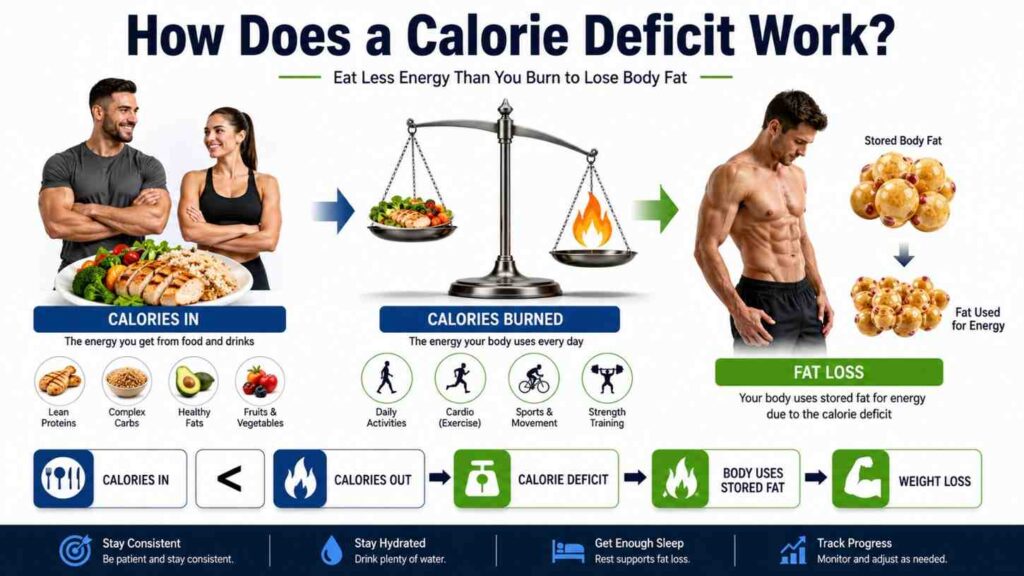
To truly appreciate why this matters, we need to look under the hood and see how your metabolism actually functions. A lot of folks think that your metabolism is just a single speed dial in your body that is either “fast” or “slow.” In reality, your metabolism is an ongoing collection of chemical processes, and your Total Daily Energy Expenditure (TDEE) is made up of four distinct components.
- Total Daily Energy Expenditure (TDEE) Components:
├── BMR: Basal Metabolic Rate (~60-70%)
├── NEAT: Non-Exercise Activity Thermogenesis (~15-20%)
├── TEF: Thermic Effect of Food (~10%)
└── EAT: Exercise Activity Thermogenesis (~5%)
The Science of Fat Metabolism
When your body experiences a shortage of incoming energy, it triggers a hormonal response. Your insulin levels drop, and hormones like glucagon and epinephrine rise. These chemical messengers signal your fat cells to release their stored fatty acids into the bloodstream.
These fatty acids travel to your cells’ powerhouses—the mitochondria—where they undergo a process called beta-oxidation. Through this pathway, the fat is broken down to create ATP (adenosine triphosphate), the cellular currency of energy. The structural byproducts of this process are simply carbon dioxide and water. You literally exhale the vast majority of your lost weight through your lungs when you breathe out, while the rest leaves your body through sweat and urine.
How Your Body Uses Energy
To maximize a calorie deficit, you have to understand the four buckets that comprise your daily energy output:
- Basal Metabolic Rate (BMR): This is the energy your body needs just to stay alive in a resting state. If you were to lie perfectly still in bed for 24 hours without moving a single muscle, your body would still burn a massive number of calories just keeping your brain, heart, liver, and kidneys running. BMR typically accounts for a whopping 60% to 70% of your total daily energy burn. According to peer-reviewed National Institutes of Health (NIH) research, managing this metabolic baseline appropriately is central to overall weight management and avoiding severe adaptive plateaus.
- Non-Exercise Activity Thermogenesis (NEAT): This is the energy expended for everything we do that is not sleeping, eating, or sports-like exercise. It includes walking to your car, pacing while on a phone call, fidgeting at your desk, cooking dinner, and maintaining your posture. NEAT is incredibly powerful and can vary by hundreds of calories from person to person based on lifestyle.
- Thermic Effect of Food (TEF): Did you know that it takes energy to digest, absorb, and process the food you eat? It’s true. Different macronutrients require different amounts of transactional energy. Protein has the highest TEF by far, requiring your body to burn roughly 20% to 30% of its consumed calories just to digest it. Carbohydrates require about 5% to 10%, while dietary fats require a mere 0% to 3%.
- Exercise Activity Thermogenesis (EAT): This is the energy you burn during intentional workouts, like running, cycling, lifting weights, or taking a fitness class. Surprisingly, for most everyday individuals, EAT only makes up about 5% of their total daily energy expenditure.
When you look at this breakdown, you quickly realize why spending two hours sweating on a treadmill to “burn off dinner” is an inefficient strategy. If you want to dive deeper into optimizing your lifestyle habits to look and feel your best naturally, check out how to lose belly fat naturally for highly practical, daily lifestyle tweaks.
Why a Calorie Deficit Is Essential for Weight Loss
I have seen countless individuals switch to a strictly organic diet, cut out sugar entirely, or eliminate gluten, only to look at the scale a month later and see that it hasn’t budged. They come to me completely demoralized, wondering if their hormones are broken or if their genetics are fundamentally flawed.
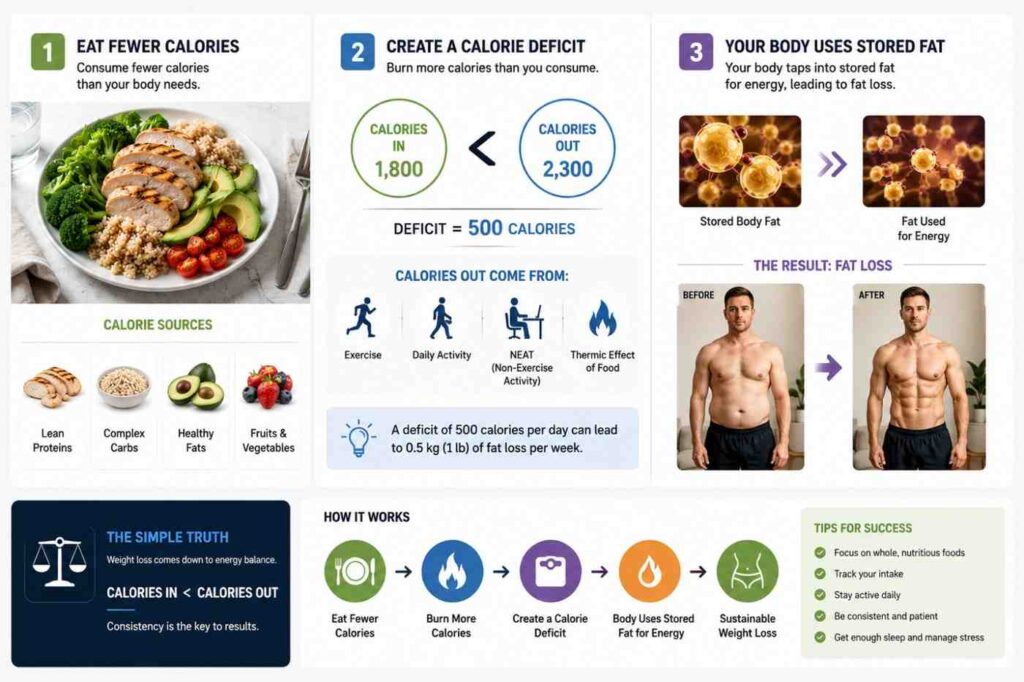
My answer is always gentle but direct: you can eat the healthiest, most organic, nutrient-dense foods on the planet, but if you are consuming them in an energy surplus, you will not drop weight. Establishing a real calorie deficit for weight loss is the true biological key to your success. Without this foundational gap, even the absolute cleanest eating habits won’t result in fat loss, which is why a structured calorie deficit for weight loss must remain your primary focus.
The Law of Thermodynamics in Fitness
The first law of thermodynamics states that energy cannot be created or destroyed; it can only change forms. Your body is bound by this universal rule. It cannot create new tissue (like fat or muscle) out of thin air, and it cannot destroy existing tissue without an energy deficit.
This is precisely why a calorie deficit explained through the lens of simple physics changes the entire game for people. It takes away the emotional guilt surrounding food. When you understand that weight loss is an energy equation, you realize that a slice of pizza doesn’t ruin your progress because it’s “bad”; it simply contributes a larger amount of energy to your daily total. If you balance that energy throughout the rest of the day or week, you can remain in a deficit and continue losing fat.
Debunking Weight Loss Myths
Let’s take a moment to dismantle a few of the most pervasive myths that keep people stuck on the diet merry-go-round:
Myth 1: Starvation mode will stop you from losing weight if you eat too little.
While metabolic adaptation is a real thing (your body slows down slightly as you get lighter to conserve energy), you cannot violate physics. If you are truly in a deficit, you will lose weight. People who think they are in “starvation mode” and not losing weight are almost always accidentally underestimating their food intake or overestimating their exercise burn.
Myth 2: Eating after 8:00 PM automatically turns food into fat.
Your body does not possess a magical clock that changes the metabolic pathway of a carbohydrate at 8:01 PM. A calorie at noon is the exact same as a calorie at midnight. What does happen is that late-night eating is usually tied to mindless snacking on high-calorie foods while watching TV. It is the extra quantity, not the timing, that causes weight gain.
Myth 3: Cardio is the only way to lose weight.
Cardio is fantastic for your heart, your mental health, and your endurance. However, it is entirely possible to lose weight without doing a single minute of traditional cardio, provided your diet establishes a reliable energy gap. Conversely, you can run five miles a day and gain weight if you eat more than those runs burn off.
How to Calculate Your Calorie Deficit
Now that you understand the underlying theory, let’s get into the practical math. How do you actually figure out what your specific numbers should look like? You don’t want to guess here. Guessing usually leads to either eating too much and seeing zero results, or eating too little and crashing hard after four days. If you are wondering how to create a calorie deficit that works uniquely for your body type, you need a precise calculation.
To get started with an exact, science-backed estimation tailored to your current physical stats, I highly recommend using the free tool available at iFitGuide.in. Using a dedicated calorie deficit calculator takes the guesswork out of the equation and gives you a solid baseline instantly. Relying on an advanced calorie deficit calculator ensures you don’t accidentally cut your food too low or keep it too high. Once you have your baseline numbers from the calorie deficit calculator, you will know exactly how many calories keep your weight stable.
Determining Your Maintenance Calories
If you want to understand how the calorie deficit calculator works behind the scenes, it first estimates your Basal Metabolic Rate using an established scientific formula, such as the Mifflin-St Jeor equation. Here is how that formula looks:
Calculate Your BMR and TDEE
For Men
BMR = (10 × Weight in kg) + (6.25 × Height in cm) − (5 × Age in years) + 5
For Women
BMR = (10 × Weight in kg) + (6.25 × Height in cm) − (5 × Age in years) − 161
Your BMR (Basal Metabolic Rate) is the number of calories your body burns at rest to perform basic functions such as breathing, circulation, and cell repair.
Once you know your BMR, multiply it by your activity level to calculate your TDEE (Total Daily Energy Expenditure).
| Activity Level | Multiplier |
|---|---|
| Sedentary (little to no exercise) | BMR × 1.2 |
| Lightly Active (exercise 1–3 days/week) | BMR × 1.375 |
| Moderately Active (exercise 3–5 days/week) | BMR × 1.55 |
| Very Active (exercise 6–7 days/week) | BMR × 1.725 |
Simple Formula:
BMR → TDEE → Calorie Deficit → Weight Loss
For sustainable weight loss, aim to consume 300–500 fewer calories than your TDEE each day.
Remember
Once you have your BMR, you multiply it by an activity factor that matches your daily lifestyle to find your Total Daily Energy Expenditure (TDEE).
The resulting number is your maintenance target. If you eat this amount every day, your weight will stay exactly where it is. Clinical nutrition guidelines published by the Mayo Clinic emphasize that tracking these lifestyle multipliers accurately prevents unexpected weight plateaus caused by shifting daily activity habits. If you use a calorie deficit calculator regularly, it becomes much easier to adjust these activity multipliers as your training routine changes over time.
Setting a Safe and Sustainable Target
Once you know your maintenance calories, you need to understand exactly how to create a calorie deficit by reducing your intake safely. Learning how to create a calorie deficit doesn’t mean slashing your food portions in half overnight. If you are figuring out how to create a calorie deficit that you can actually stick to for months, a moderate approach is always best.
Instead, aim for a moderate, sustainable deficit of 20% below your maintenance calories. For most individuals, this works out to a reduction of roughly 300 to 500 calories per day.
| Target Goal | Caloric Deficit Range | Expected Weekly Fat Loss | Best Suited For |
| Conservative | 200 – 300 kcal below maintenance | ~0.5 lbs (0.2 kg) | Most general fitness enthusiasts are looking for steady, sustainable progress |
| Moderate | 400 – 500 kcal below maintenance | ~1.0 lbs (0.45 kg) | Most general fitness enthusiasts looking for steady, sustainable progress |
| Aggressive | 600 – 800 kcal below maintenance | ~1.5 – 2 lbs (0.7-0.9 kg) | Individuals with higher starting body fat percentages under proper guidance |
When managing a proper calorie deficit diet, a moderate reduction allows you to shed body fat steadily while still having enough fuel to enjoy your life. A well-designed calorie deficit diet ensures your energy levels remain high during workouts. If you stick to a balanced calorie deficit diet, you won’t experience the severe brain fog or constant exhaustion associated with crash dieting. It turns weight loss from a torturous sprint into an entirely manageable marathon.
Best Calorie Deficit Foods
Here is a phrase I want you to burn into your memory: Volume eating is a superpower.
When you are following a specific calorie deficit diet, the physical volume of the food you consume matters immensely. Your stomach has stretch receptors that signal your brain when it is physically full. If you eat tiny amounts of highly concentrated, calorie-dense foods while trying to maintain a calorie deficit for weight loss, your stomach will remain physically empty, and your brain will continue screaming for food.
To feel completely satisfied while staying in your target range, you need to structure your daily eating around low-calorie, nutrient-dense choices. These are the ultimate calorie deficit foods.
High-Volume, Low-Calorie Options
The absolute best choices for a calorie deficit diet are those that take up a massive amount of physical space on your plate but contribute very little energy. Think about leafy greens, broccoli, cauliflower, cucumbers, zucchini, bell peppers, and asparagus.
For example, you could eat an entire pound of fresh strawberries and only consume about 150 calories. On the flip side, a tiny handful of potato chips or a small cookie can easily pack 150 to 200 calories, leaving you wanting more within ten minutes. By filling half of your plate with vegetables and low-sugar fruits at every single meal, you can physically volume-eat your way to fullness while keeping your total calorie count low.
The Power of Lean Protein and Fiber
If volume is the first pillar of satiety, protein and fiber are the second and third pillars. Lean protein sources should form the foundational anchor of every single meal you prepare on a calorie deficit diet.
- Satiety Trifecta:
[ Volume (Vegetables/Greens) ] + [ Lean Protein (Chicken/Fish/Tofu) ] + [ Dietary Fiber (Whole Grains/Legumes) ]
Protein is incredibly satiating because it stimulates the release of fullness hormones like PYY and GLP-1, while simultaneously suppressing ghrelin, the hormone that makes you feel hungry. This nutritional strategy matches long-standing advice from Harvard Health Publishing, which notes that higher protein distribution shifts body composition toward fat loss rather than metabolic slowing. Excellent lean protein sources include:
- Skinless chicken breast or turkey mince
- White fish (such as cod, tilapia, or haddock)
- Egg whites
- Low-fat Greek yogurt or cottage cheese
- Tofu, tempeh, and seitan for plant-based options
Fiber is equally critical. It slows down the rate of digestion, ensuring a steady, prolonged release of glucose into your bloodstream rather than a sharp spike followed by a rapid crash. Make sure you are incorporating high-fiber whole foods like oats, quinoa, lentils, black beans, chia seeds, and raspberries into your daily rotation.
Calorie Deficit Meal Plan for Beginners
Let’s look at how this looks in the real world. A proper calorie deficit diet shouldn’t look like a punishment. It shouldn’t consist entirely of plain, unseasoned chicken breast and boiled broccoli out of a Tupperware container. You can eat flavorful, delicious meals that make you look forward to sitting down at the table.
Here is a practical, easy-to-follow, three-day sample menu designed to hit roughly 1,600 to 1,700 calories. It is packed with high-volume, fiber-rich, and protein-heavy choices to keep your energy high and your cravings low.
Day 1 Sample Menu
- Breakfast: High-Protein Oatmeal Bowl. Cook 40g of rolled oats in water or unsweetened almond milk. Stir in one scoop of your favorite whey or plant protein powder right after cooking. Top with 50g of fresh blueberries and a light sprinkle of cinnamon.
- Lunch: Mediterranean Grilled Chicken Salad. 150g of grilled chicken breast served over a massive bed of mixed baby spinach, shredded cucumbers, cherry tomatoes, and diced red onions. Toss with one tablespoon of light olive oil dressing and a squeeze of fresh lemon juice.
- Snack: 200g of low-fat Greek yogurt mixed with a handful of crushed raspberries.
- Dinner: Baked Salmon and Roasted Green Veggies. 120g of baked salmon fillet served alongside a generous portion of roasted broccoli florets and asparagus spears tossed in garlic powder and a touch of sea salt.
Day 2 Sample Menu
- Breakfast: Fluffy Egg White Veggie Scramble. Scramble one whole egg with three egg whites, a handful of baby spinach, chopped bell peppers, and sliced mushrooms. Serve with two slices of toasted whole-grain bread.
- Lunch: High-Fiber Turkey and Black Bean Bowl. 150g of lean turkey mince cooked with taco seasonings, served over 100g of cooked brown rice, 50g of black beans, and shredded lettuce. Top with two tablespoons of fresh salsa and a quarter of an avocado for healthy fats.
- Snack: One medium apple sliced up and served with one tablespoon of natural peanut butter.
- Dinner: Lean Beef or Tofu Stir-Fry. 140g of lean beef strips (or extra-firm tofu) stir-fried in a non-stick pan with a splash of low-sodium soy sauce, ginger, garlic, and a massive mix of sugar snap peas, carrots, and baby corn.
Day 3 Sample Menu
- Breakfast: Creamy Berry Protein Smoothie. Blend one scoop of vanilla protein powder, one cup of frozen mixed berries, a handful of fresh spinach (you won’t taste it, I promise), 200ml of unsweetened almond milk, and a tablespoon of chia seeds.
- Lunch: Tuna Salad Whole-Wheat Wrap. Mix one can of water-packed tuna with one tablespoon of light mayonnaise or plain Greek yogurt, mustard, and diced celery. Wrap it up tightly in a large whole-wheat tortilla with plenty of crunchy romaine lettuce.
- Snack: 30g of raw almonds or mixed walnuts along with a warm cup of green tea.
- Dinner: Grilled White Fish and Sweet Potato Mash. 150g of grilled cod or tilapia seasoned with paprika, served with 120g of mashed sweet potato and a large side of steamed green beans.
Notice the theme across this entire sample layout? Every single meal shows you how to create a calorie deficit without leaving your stomach empty. This structure keeps your blood sugar stable and keeps you physically satisfied throughout the day.
Common Calorie Deficit Mistakes
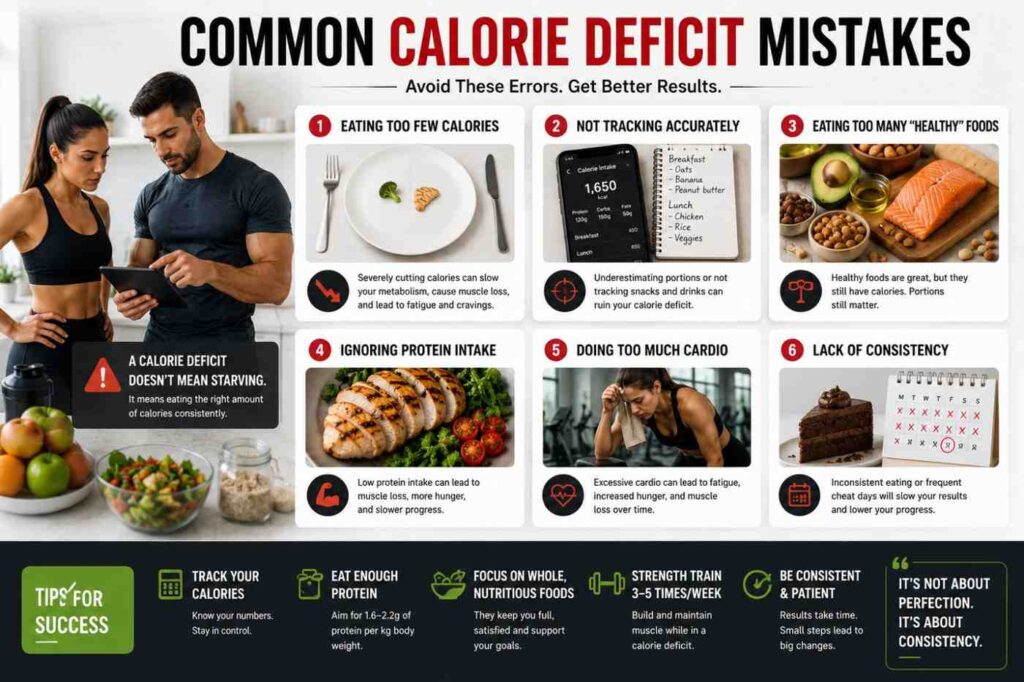
Over my years of coaching clients, I have noticed that when people struggle to drop weight, it is rarely due to a lack of effort. More often than not, they are working incredibly hard, but their efforts are being unintentionally undermined by a few common blind spots.
Let’s address these openly so you can avoid the frustrating pitfalls that hold so many well-meaning people back.
Underestimating Liquid Calories
This is one of the quickest ways to accidentally erase a hard-earned deficit. Calories that you drink do absolutely nothing to satisfy your physical hunger. Your brain does not register liquid calories the same way it registers solid food, meaning you can drink a massive number of calories and still feel completely empty inside.
Think about your daily habits. A large cafe latte with whole milk and syrup can easily pack 300 to 400 calories. A glass of fruit juice or sweet tea adds another 150 calories. A weekend alcoholic beverage or two can tack on hundreds more. If your maintenance target is 2,000 calories and you are checking a calorie deficit calculator to stay on track, drinking just one fancy coffee and a glass of juice can completely wipe out your entire daily deficit without you ever realizing it. Stick primarily to water, black coffee, herbal teas, and calorie-free sparkling waters.
Ignoring Hidden Fats and Oils
Cooking oils are the ultimate ninja calories of the culinary world. One single tablespoon of olive oil, coconut oil, or butter contains roughly 120 calories.
- The Hidden Oil Trap:
2 tablespoons of unmeasured cooking oil = ~240 hidden calories
(This can easily wipe out half of your daily target deficit!)
When many people cook, they don’t measure their oil; they just free-pour it directly into the pan. If you free-pour oil twice a day, you could easily be adding 240 to 300 unrecorded calories to your daily total. You think you are eating a clean, low-calorie meal of chicken and vegetables, but the hidden cooking fat has completely shifted the math. Invest in a simple oil spray bottle or use a measuring spoon every single time you cook to protect your hard work.
Overestimating Exercise Burn
We have all been there. You finish a grueling, sweaty 45-minute workout on the elliptical machine, you look down at the digital display, and it proudly tells you that you burned 600 calories. You feel amazing, so on your way home, you stop and grab a 500-calorie smoothie because you think you have earned it.
Here is the cold, hard truth: fitness trackers, smartwatches, and cardio machine displays are notoriously inaccurate. Studies have routinely shown that these devices can overestimate your actual exercise calorie burn by anywhere from 20% to as much as 90%.
If you use your watch’s calorie burn metric as a green light to eat more food, you will almost certainly stall your progress. Treat exercise as a tool for heart health, mental clarity, and athletic performance—never as a license to overeat.
How Much Weight Can You Lose in a Calorie Deficit?
One of the very first questions a new client asks me is: “Coach, how fast can I lose this weight?” I completely understand the desire for speed. We live in a world of instant gratification, and when you decide to change your life, you want to see the results in the mirror by next Tuesday. But real, lasting structural changes take time. Let’s look at what a healthy, realistic timeline actually looks like.
Realistic Weight Loss Timelines
As a rule of thumb, a safe, sustainable, and realistic rate of fat loss is 0.5 to 2 pounds (0.2 to 1 kg) per week. If you understand how to create a calorie deficit with proper patience, you will achieve much more permanent results.
In the first week or two of starting your journey, you might see the scale drop significantly faster—sometimes 4 to 6 pounds in a single week. Do not get discouraged when this initial rapid drop slows down. That early loss is primarily water weight and glycogen (stored carbohydrates), leaving your body as you reduce your food volume. Once your body stabilizes, your steady, long-term progress will settle into that 1 to 2-pound weekly range.
- Expected Progress Breakdown:
├── Week 1-2: Rapid drop (primarily water weight & reduced glycogen)
└── Week 3+: Steady fat loss (0.5 to 2 lbs per week)
If you try to push past this rate by starving yourself, you will face diminishing returns. Your body will begin breaking down muscle tissue for fuel, your energy levels will completely tank, and you will set yourself up for a classic rebound weight gain down the road. Slow, steady progress generated by a consistent calorie deficit for weight loss is the only kind of progress that sticks permanently.
The Role of Scale Fluctuations
I need to give you a serious warning: the scale is a useful tool, but it can also be a psychological mind game if you don’t understand how your body handles water.
Your weight can easily fluctuate by 2 to 5 pounds from one day to the next. These rapid shifts are completely normal and have absolutely nothing to do with gaining or losing body fat. Daily scale fluctuations are typically caused by:
- Sodium Intake: If you eat a meal with higher sodium levels, your body will temporarily hold onto extra water to maintain its fluid balance.
- Carbohydrate Intake: Every single gram of carbohydrate you store in your muscles holds onto roughly 3 to 4 grams of water. A high-carb day will make the scale jump, even if you stayed within your target deficit.
- Digestion: The physical weight of undigested food moving through your gastrointestinal tract shows up on the scale.
- Stress and Sleep: High stress and poor sleep raise your cortisol levels, which causes your body to retain extra subcutaneous water.
To keep your sanity intact, do not look at any single daily scale weight as a definitive pass or fail grade. Instead, weigh yourself daily under identical conditions (in the morning, after using the restroom, before eating), take a weekly average, and look at the long-term trend lines over several weeks.
Calorie Deficit and Exercise

While you can technically drop weight through changes to your diet alone, combining your nutrition plan with the right kind of physical activity is the true secret to completely transforming your physique, your health, and your confidence.
Resistance Training vs. Cardio
If your only goal is to make the number on the scale go down, cardio is a decent tool. But if your goal is to lose fat while building a lean, strong, and athletic body, resistance training is non-negotiable.
When you are in an energy gap, your body is looking for tissue to break down for fuel. If you do not give your body a compelling biological reason to keep your muscles, it will gladly burn muscle tissue right along with fat. Lifting weights or performing bodyweight resistance training sends a loud signal to your nervous system that your muscles are essential for survival. This forces your body to protect your muscle tissue and draw its energy almost exclusively from your fat stores instead.
Furthermore, lifting weights is a powerful way to naturally optimize your overall hormonal profile. For those looking to maximize their vitality, energy, and overall health alongside their fat loss journey, learning how to increase testosterone naturally offers a perfect, complementary roadmap for boosting body composition and recovery.
The Myth of “Spot Reduction”
I hear it every single week: “Coach, what exercise can I do to burn the fat off the bottom of my stomach?” or “How do I tone just my arms?”
Let’s put this myth to bed once and for all: you cannot spot-reduce fat.
Doing thousands of crunches will not burn fat from your midsection, and doing endless tricep extensions will not melt fat away from your arms. Exercises strengthen and build the muscles underneath the fat, but they have zero control over where your body chooses to harvest fat cells for energy.
Your body loses fat in a systemic, genetic pattern. Think of your body fat like a swimming pool. When you scoop water out of the shallow end, the entire water level drops uniformly across the whole pool; you don’t leave a dry hole in one corner. Be patient, stay consistent with your target deficit, and your body will eventually pull fat from your stubborn areas in due time.
Who Should Avoid Extreme Calorie Deficits?
As a responsible fitness professional, I must emphasize that a fat loss protocol is not appropriate for everyone at all times. Your health and long-term well-being must always come before a physical goal.
Signs of an Unhealthy Deficit
If you push your energy restriction too far or stay in a prolonged fat loss phase for too long without a break, your body will let you know. Pay close attention to these warning signs:
- Chronic, unrelenting fatigue that doesn’t improve with a good night’s sleep.
- Persistent brain fog, irritability, and severe mood swings.
- Loss of a regular menstrual cycle for women (hypothalamic amenorrhea).
- Constant, severe hair thinning or brittle nails.
- Always feeling physically cold, even when you are in a warm room.
- An unhealthy, obsessive fixation on food tracking, calories, and body checks.
If you recognize these symptoms in yourself, it is an immediate sign that your deficit is far too aggressive or that your body needs a sustained break at your maintenance intake to recover its metabolic and hormonal health.
When to Seek Professional Guidance
Certain individuals should never enter a weight loss phase without direct medical supervision. If you have a history of disordered eating or an active eating disorder, tracking food or intentionally restricting energy can be incredibly triggering and harmful.
Additionally, pregnant or breastfeeding mothers, growing teenagers, and individuals managing complex chronic health conditions should always work alongside their primary healthcare team. If you ever feel overwhelmed or uncertain about your physical approach, visit iFitGuide.in for trusted resources, comprehensive articles, and professional wellness guidance to support your journey safely.
Frequently Asked Questions
1. Can you build muscle while in a calorie deficit?
Yes, this process is known as body recomposition. It is entirely possible, but it is most effective for three specific groups: beginners who are new to structured weight training, individuals with a higher starting body fat percentage, and those returning to the gym after a long layoff. To maximize your chances of building muscle while dropping fat, ensure your deficit is highly moderate, keep your protein intake consistently high, and lift weights with high intensity.
2. Why am I tracking my food but still not losing weight?
If the scale has been completely stuck for more than three to four weeks, you are not in an energy deficit. It is physically impossible to be in a true deficit and not lose weight. The most common culprit is accidental tracking inaccuracies. Are you measuring your cooking oils, salad dressings, and sauces? Are you using a digital kitchen scale to weigh your portions, or are you just guessing with your eyes? Eyeballing portions can easily lead to underestimating your food intake by 30% to 50%. Tighten up your tracking accuracy for two weeks, and you will likely see the scale start moving again.
3. How long should I stay in a deficit?
As a general rule, you should avoid staying in a continuous fat loss phase for longer than 12 to 16 weeks at a time. Spending too much time in a deficit can cause your metabolism to adapt downward and lead to psychological diet fatigue. After 12 to 16 weeks of steady progress, it is highly beneficial to bring your food intake back up to your current maintenance level for 2 to 4 weeks. This “diet break” gives your thyroid hormones, leptin levels, and mental focus a much-needed reset before you start your next fat loss phase.
4. Can I lose weight by just eating less without exercising?
Yes, absolutely. Since weight loss is driven by the energy balance equation, you can establish a deficit purely by reducing your food intake. However, combining your diet with exercise is highly recommended. Exercise helps protect your lean muscle tissue, boosts your daily energy expenditure, improves your cardiovascular health, and makes it significantly easier to maintain your new weight long-term.
5. What should I do when my weight loss stalls?
First, verify that your tracking is 100% accurate. If it is, and your weight has truly plateaued for a month, your body has likely adapted to your lighter weight, meaning your old maintenance calories have dropped. To jumpstart your progress again, you have two options: slightly reduce your daily intake by another 100 to 150 calories, or increase your daily physical activity (like aiming for an extra 2,000 steps per day).
Conclusion: Your Sustainable Path Forward
At the end of the day, successful, permanent fat loss isn’t about finding a secret shortcut, cutting out your favorite foods, or suffering through extreme starvation protocols. It is about understanding the fundamental physics of your body, treating yourself with respect, and building sustainable, everyday habits that you can maintain for years to come.
- Three Pillars of Long-Term Success:
1. Consistency over perfection
2. High-volume, nutrient-dense nutrition
3. Patient, data-driven tracking
Be patient with yourself. Remember that your weight will fluctuate from day to day, and that one indulgent meal with friends will never ruin your long-term progress. Focus on hitting your numbers consistently, filling your plate with high-quality lean proteins and fiber, and keeping your body active.
You now have the exact science, the practical math, and the coaching blueprint required to take full control of your fitness journey. Trust the process, stay consistent, and let the results follow naturally.