Kegel exercises for men are one of the most effective ways to strengthen your pelvic floor, improve bladder control, boost core stability, and enhance sexual performance naturally. While many people associate Kegel exercises with women, men can benefit just as much from this simple yet powerful routine. If you’re wondering how to do Kegel exercises for men, this complete guide explains everything—from finding the correct muscles to performing 7 Kegel exercises for men step by step. By following this expert blueprint consistently, you’ll build better pelvic strength, improve stamina, and support your overall fitness.
If you are currently browsing through our collection of fitness blogs for beginners, looking for ways to build a truly unbreakable foundation, you cannot afford to leave this muscle group behind. Your core isn’t just about six-pack abs or a heavy deadlift. It starts from the absolute bottom. In my ten-plus years of working as a certified fitness coach, I have seen men of all fitness levels—from elite weightlifters to desk-bound corporate professionals—completely transform their physical stamina by mastering one simple, invisible habit: kegel exercises for men.
Let’s break down the mechanics, clear away the awkwardness, and talk about this like two friends having a coffee. No judgment. No overly dense medical jargon that requires a degree to decode. Just pure, actionable, expert guidance.
One of the biggest reasons fitness experts recommend Kegel exercises for men is that they target muscles that are often ignored during traditional workouts. A stronger pelvic floor supports better posture, improves bladder control, enhances athletic performance, and contributes to long-term pelvic health.
Why Your Pelvic Floor Is the Secret Anchor of Your Entire Body
What are we actually talking about when we discuss the pelvic floor? Picture a highly flexible, muscular hammock that spans from your tailbone right up to your pubic bone. It acts as the structural floor support for your bladder, your bowels, and your intestines. When this hammock is taut, resilient, and strong, everything functions like a perfectly tuned sports car. But when it goes soft from years of prolonged sitting or general neglect? That is when you start noticing frustrating issues like unexpected bladder leaks when you cough, or a sudden, unexplained drop in your baseline physical endurance.
The Male Core Canister
| Core Component | Role |
|---|---|
| 🫁 Top | Diaphragm (Breathing) |
| 💪 Sides & Front | Abdominals & Obliques |
| 🦴 Back | Spinal Stabilizers |
| 🔽 Bottom | Pelvic Floor Muscles |
How It Works:
Think of your core as a sealed pressure canister. The diaphragm forms the top, your abdominal and back muscles create the sides, and the pelvic floor muscles act as the bottom foundation. When all four parts work together, they improve posture, lifting strength, balance, and bladder control.
Think of your entire core as a sealed pressure canister. The diaphragm forms the top lid, your abs and back muscles create the sturdy sides, and your pelvic floor serves as the absolute base. If the bottom of that canister is weak, the entire system loses structural integrity. You can’t generate maximum power during a heavy squat, and you certainly can’t maintain proper posture during long workdays.
Stripping Away the Social Stigma Around Male Pelvic Health
I remember working with an anonymized client named Marcus a few years back. Marcus was a highly competitive regional powerlifter in his early thirties who came to me because his lower back was constantly aching despite flawless lifting form. During our initial assessment, he casually mentioned that he’d started experiencing minor urinary leakage whenever he hit his heaviest raw lifting sets. He was absolutely mortified to admit it. He thought it meant his body was prematurely breaking down.
I looked him dead in the eye and said, “Marcus, your spine isn’t the issue here. Your structural foundation is simply leaking pressure because you’ve never trained the bottom of your core.” I walked him through how to properly perform kegel exercises for men, integrating them directly into his bracing routine. Within six short weeks, his bladder leaks completely vanished, his lower back pain cleared up, and his deadlift max actually increased because his core could suddenly handle the internal pressure safely.
There is absolutely nothing unmasculine about taking care of the muscles that control your most basic physical functions. It is simply smart, strategic athletic maintenance.
The Hidden Bedroom Payoffs: Boosting Stamina and Sexual Performance
Let’s pivot and address the elephant in the room. While improved bladder health is incredible, an overwhelming majority of guys initially look into this topic because they want to know about the kegel exercises benefits sexually male athletes and everyday men rave about online. Can squeezing these hidden internal muscles actually make a tangible difference in your sex life?
Yes. Absolutely. It is pure, uncomplicated anatomy.
The pelvic floor is home to the bulbocavernosus muscle, which is heavily responsible for determining blood flow velocity and structural rigidity during arousal. By actively strengthening this specific muscular pathway, you are training your body to efficiently manage and sustain peak local blood flow. According to clinical data published on PubMed / NIH studies, targeted pelvic floor muscle training shows a remarkably high success rate in helping men naturally regain control over their sexual endurance and performance metrics.
Regaining Peak Control and Sexual Confidence
When these muscles are weak, blood flow leaves the pelvic region just as quickly as it arrives, which can lead to premature fatigue or soft erections. By utilizing targeted kegel exercises for men, you are building the exact muscular endurance required to maintain rigidity and delay climax until the moment you choose. It is very much like learning how to modulate the clutch pedal in a manual car. Once you possess the muscular awareness, you are the one completely in control of the ride.
For guys looking to naturally boost their performance without relying on quick-fix pills or synthetic supplements, establishing a rock-solid pelvic floor routine is the absolute gold standard. It enhances your natural stamina from the inside out, providing a massive boost to your overall sexual confidence that carries over into every single aspect of your daily life.
Before learning how to do Kegel exercises for men, it’s important to identify the correct pelvic floor muscles. Using the proper muscles ensures you receive the maximum benefits while avoiding common mistakes like squeezing your glutes or holding your breath.
Step-by-Step Guide: How to Find and Isolate Your Pelvic Floor Muscles
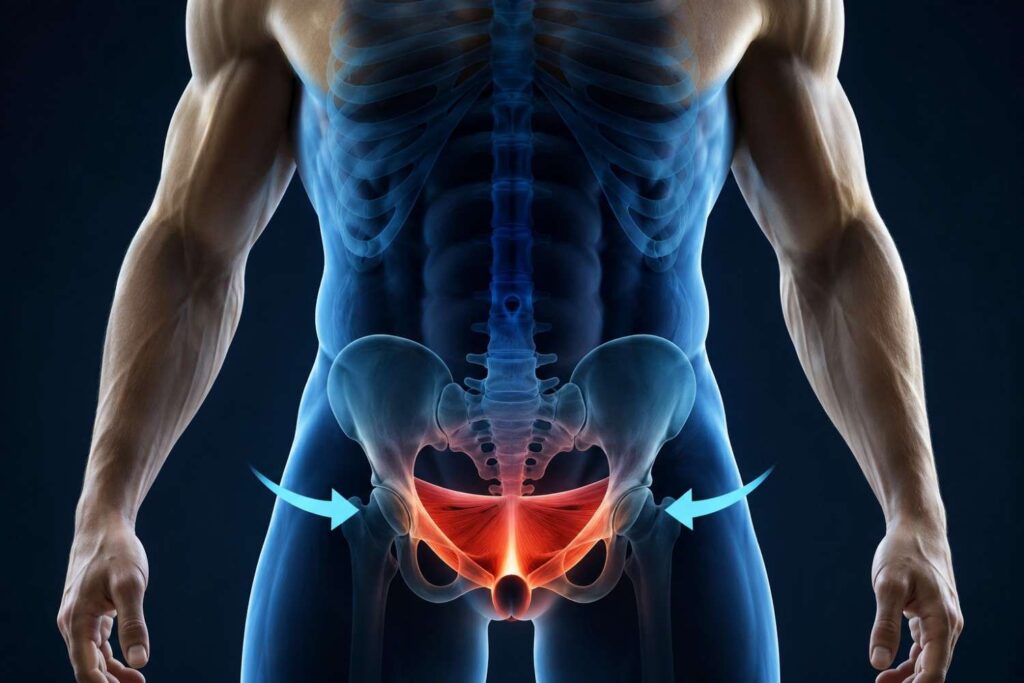
Now here is where most people get confused and incredibly frustrated. Because you cannot see these muscles working in a mirror, it is ridiculously easy to cheat and use the wrong parts of your body. When I ask a new client to perform a pelvic contraction, they almost always hold their breath, squeeze their glutes until they shake, or aggressively suck in their stomach.
None of those actions does anything for your pelvic floor. Here is how to do kegel exercises for men without accidentally wasting your energy on muscle groups that don’t matter.
The Mid-Stream Trick (For Isolation Only)
The absolute easiest way to identify the exact muscles we are targeting is to try stopping your urine flow mid-stream the next time you are using the bathroom. The muscles you engage to halt that flow are your pelvic floor muscles.
Critical Safety Warning: Do not make a habit of doing your actual daily exercise sessions while actively urinating. Doing this repeatedly can confuse your bladder reflexes and eventually lead to urinary tract infections or incomplete bladder emptying. Use this trick once or twice just to locate the muscle, and then leave it for the bathroom.
The Mirror and Vacuum Methods
If you want a safe way to check your form outside the bathroom, stand naked in front of a mirror and attempt to pull your penis and scrotum upward toward your belly button without moving your hips or tightening your thighs. You should see a distinct, subtle lifting motion.
Another highly effective mental image is imagining that you are walking deep into cold ocean water. That sudden, automatic internal contraction your body does to lift your sensitive areas out of the freezing water? That is exactly the sensation of a perfect pelvic floor squeeze.
Now that you’ve identified the correct muscles, it’s time to begin these 7 Kegel exercises for men step by step. Start slowly, focus on proper technique, and increase the duration of each contraction as your strength improves.
7 Kegel Exercises for Men Step by Step: Your Complete Workout Routine
Let’s get into the practical, actionable workout protocol. We are going to break down 7 kegel exercises for men step by step so you can seamlessly transition from a complete beginner to an advanced practitioner. You do not need any special equipment, a gym membership, or fancy gear to do these. You just need a quiet place to lie down or sit comfortably.
1. The Supine Basic Hold (The Beginner Foundation)
This is where every single person should start. Lying flat on your back takes gravity out of the equation, making it significantly easier to isolate the correct muscles without your thighs or lower back muscles stepping in to help.
- Step 1: Lie down flat on your back on a comfortable exercise mat or your bed. Bend your knees at a 45-degree angle and keep your feet planted firmly on the floor, roughly hip-width apart. Rest your hands loosely by your sides.
- Step 2: Take a deep, slow breath in through your nose, allowing your belly to naturally expand. As you slowly exhale through your mouth, gently contract your pelvic floor muscles. Imagine pulling them up away from the floor.
- Step 3: Hold that gentle contraction steadily for 3 full seconds. Keep breathing normally throughout the hold—do not hold your breath!
- Step 4: Completely release the muscle for 3 full seconds. This relaxation phase is just as vital as the squeeze. Repeat this basic loop for 10 total repetitions.
2. Quick-Flick Squeezes (Building Fast-Twitch Reflexes)
Your pelvic floor contains both slow-twitch muscles (for long-term endurance) and fast-twitch muscles (for sudden pressure changes, like coughing or sneezing). This exercise trains those rapid-response fibers.
- Step 1: Maintain the exact same supine position on your back with your knees comfortably bent. Take a moment to fully relax your entire body.
- Step 2: Quickly and powerfully squeeze your pelvic floor muscles as hard as you can for just 1 single second, then immediately release them completely.
- Step 3: Rest for 1 second, then snap it shut again. Think of it like flicking a light switch on and off in rapid succession.
- Step 4: Execute a continuous block of 10 quick flicks, take a 30-second break, and then perform one more set of 10.
3. The Seated Elevator Lift (Developing Graduate Control)
Once you can easily manipulate the muscles while lying down, it is time to progress to a seated position where gravity begins to apply downward pressure on your pelvic floor.
- Step 1: Sit up straight in a firm, straight-backed wooden or office chair. Keep your feet completely flat on the floor and place your hands flat on your thighs. Do not slouch forward.
- Step 2: Imagine your pelvic floor is an elevator sitting at the ground floor of a building. Take a breath, and as you exhale, gently squeeze to lift the elevator up to the 1st floor. Hold it there for 2 seconds.
- Step 3: Without relaxing, squeeze slightly harder to lift the elevator up to the 2nd floor. Hold for another 2 seconds. Finally, squeeze with maximum controlled effort to reach the 3rd floor.
- Step 4: Slowly reverse the journey. Lower down to the 2nd floor, then the 1st floor, and then fully relax back down to the ground floor. Aim for 5 complete elevator trips per session.
4. The Glute Bridge Pelvic Pulse (Integrating Global Movements)
Here, we begin blending internal pelvic floor engagement with larger, functional lower-body movements. This teaches your body to use these muscles during actual athletic activity.
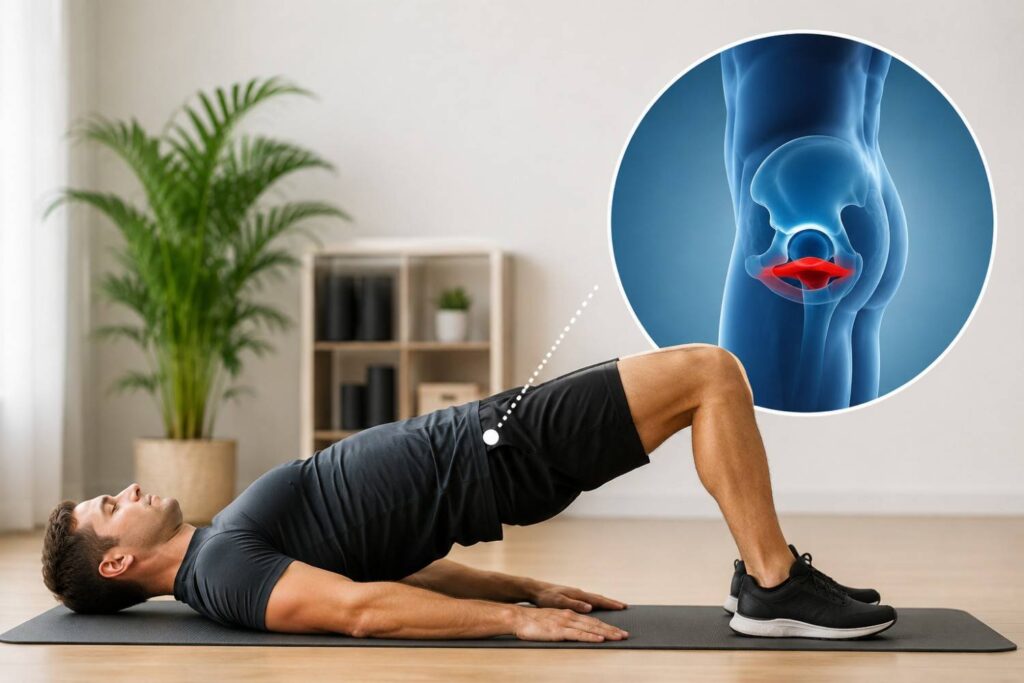
| Glute Bridge Pelvic Pulse | End – End |
|---|---|
| Starting Position | Lie on your back with your knees bent, feet flat on the floor, and arms resting by your sides. |
| Movement | Lift your hips toward the ceiling until your body forms a straight line from your shoulders to your knees. |
| At the Top | Squeeze your pelvic floor muscles and glutes together. |
| Hold | Maintain the contraction for 3 seconds while breathing normally. |
| Return | Lower your hips slowly and completely relax before the next repetition. |
- Step 1: Lie flat on your back with your knees bent and feet flat on the floor close to your glutes.
- Step 2: Drive through your heels to lift your hips up toward the ceiling until your body forms a straight line from your knees to your shoulders.
- Step 3: Once you reach the absolute top of the bridge position, strongly engage your pelvic floor muscles and hold the contraction for 3 seconds while keeping your glutes engaged.
- Step 4: Lower your hips slowly back down to the exercise mat while simultaneously relaxing your pelvic floor. Perform 10 controlled repetitions.
5. The Standing Endurance Anchor (Real-World Application)
Honestly, this is the position you spend most of your active day in. Master this step, and you can discreetly practice your routine while standing in line at the grocery store or waiting for a meeting to start.
- Step 1: Stand completely upright with your feet spaced shoulder-width apart. Distribute your body weight evenly across both feet. Keep your shoulders relaxed and down.
- Step 2: Engage your lower abdominal muscles just a tiny bit, then initiate a firm, sustained contraction of your pelvic floor.
- Step 3: Maintain this steady, moderate squeeze for 5 to 10 full seconds. Focus entirely on keeping your glutes and hamstrings completely soft while you hold this internal anchor.
- Step 4: Let the contraction dissolve slowly over 5 seconds. Repeat this standing hold 5 times.
6. The Deep Squat Release (Mastering Length and Relaxation)
Many active men actually suffer from an overly tight, hypertonic pelvic floor. If you never learn to fully drop and relax these muscles, you can experience pelvic pain. This exercise focuses heavily on the essential lengthening phase.
- Step 1: Stand with your feet slightly wider than shoulder-width, pointing your toes slightly outward.
- Step 2: Lower yourself down into a deep, controlled squat. Go as low as your mobility safely allows while keeping your chest upright and your heels glued to the floor.
- Step 3: At the bottom of the squat, focus on sending your breath all the way down into your pelvis. Intentionally visualize your pelvic floor lengthening, widening, and opening up entirely. Do not squeeze here; focus on total release.
- Step 4: Hold that deep, relaxed stretch for 5 seconds, then drive through your legs to return to a standing position, executing a gentle, protective contraction on the way up. Repeat 8 times.
7. The Supine Deadbug Integration (Advanced Core Stability)
This is the ultimate test of functional pelvic floor endurance. We are going to challenge your ability to hold an internal contraction while your limbs move dynamically through space.
- Step 1: Lie flat on your back, raising your arms straight up toward the ceiling and bending your knees at a 90-degree angle so your shins are parallel to the floor (the classic tabletop position).
- Step 2: Fully engage your pelvic floor muscles and press your lower back firmly down into the floor so there is zero gap beneath your spine.
- Step 3: Keeping your pelvic floor locked in, slowly extend your right arm backward over your head while simultaneously straightening your left leg out long just above the floor.
- Step 4: Bring them back to the center position, switch sides, and extend your left arm and right leg. Keep alternating for 10 total reps, maintaining that deep internal engagement the entire time.
Practicing these Kegel exercises for men consistently three to four times per week can significantly improve pelvic floor strength, bladder control, core stability, and overall confidence. Remember that consistency matters much more than intensity. Most men begin noticing improvements after practicing Kegel exercises for men consistently for four to six weeks. Better bladder control often appears first, while increased endurance and improved sexual performance usually develop after several more weeks of regular training.
Tracking Your Pelvic Floor Progress: What to Expect
| Phase | Timeline | Primary Physical Milestone | Focus Area |
| Phase 1 | Week 1 – 2 | Improved mind-muscle connection and easier muscle isolation | Eliminating muscle cheating (glutes/abs) |
| Phase 2 | Week 3 – 6 | Noticeable reduction in accidental urinary leaks; enhanced core stiffness | Increasing hold duration to 10 seconds |
| Phase 3 | Week 7 – 12+ | Significant improvements in sexual stamina and pelvic control | Functional integration during heavy lifting |
Common Mistakes That Will Completely Ruin Your Progress
In my experience, almost every single guy who tells me that kegel exercises for men do not work is simply making one of three very common procedural errors. Let’s fix them right now so you don’t waste weeks of effort.
Mistake 1: Turning It Into an Abdominal Workout
The absolute most frequent error I see is pulling the stomach in violently during the squeeze. Your abdominal wall will naturally engage a tiny bit due to shared neural pathways, but it should never be the primary driver. If your belly button is violently sucking back toward your spine, you are creating excessive intra-abdominal pressure that actually pushes down on your pelvic floor rather than pulling it up. Keep your hands on your stomach during your first few sessions; if you feel your abs hardening significantly, back off the intensity.
Mistake 2: Holding Your Breath Like a Diver
When people concentrate hard on isolating a tricky muscle, they instinctively freeze their breath. This is incredibly counterproductive. Holding your breath increases the pressure inside your chest and abdomen, which forces your pelvic floor to bear a heavy downward load. You need to be able to hold a conversation while performing kegel exercises for men. If you find yourself holding your breath, try counting aloud from one to five during every single contraction.
Mistake 3: Overtraining and Refusing to Rest
More is not always better. I have had clients get so excited about the potential benefits that they start doing hundreds of contractions every single day. You see, the pelvic floor is just like any other muscle group in your body. It can get overworked, exhausted, and strained. An overfatigued pelvic floor muscle is a weak muscle, and it will actually cause your urinary control to temporarily worsen. Stick to the prescribed reps, and always give your muscles a full day of lighter recovery if they feel fatigued or achy.
Real Expert Guidance: Visual Demonstrations and Video Walkthroughs
Sometimes, reading about an invisible muscle group isn’t quite enough to make the concept click in your mind. To truly minimize your learning curve and prevent accidental form errors, it is incredibly helpful to see a professional physical therapist break down the precise pelvic movement mechanics visually.
Watching a high-quality video demonstration can significantly lower your bounce rate when learning this habit and ensure you aren’t putting strain on your lower back or hip flexors. Take a quick look at this thoroughly detailed, step-by-step visual guide designed to show you exactly how the male pelvic bowl tilts and engages during targeted training:
How to Seamlessly Blend Your Pelvic Routine with Beginner Fitness Goals
If you are currently building a foundational exercise habit using the guides over on our main portal at iFitGuide.in, you don’t need to treat your pelvic floor work as an entirely separate, time-consuming chore. The absolute best way to ensure long-term consistency is to anchor it directly to habits you already perform every single day without fail.
- During Your Daily Commute: Practice your Seated Elevator Lifts every time you hit a red light or while riding the train to work.
- At Your Office Desk: Set a subtle silent timer on your phone to remind you to do 3 sets of Standing Endurance Anchors every afternoon around 2:00 PM when your posture naturally starts to slouch.
- As Part of Your Existing Gym Routine: Use your existing gym routine, use your supine deadbug integrations as a core warm-up right before you perform any heavy compound lifts or bodyweight circuits.
By integrating these small, invisible movements into your regular routine, you ensure your body gets the consistent training it needs without requiring you to carve out extra blocks of time from your busy schedule.
Final Thoughts
Kegel exercises for men are one of the easiest and most effective ways to improve pelvic floor strength, bladder control, core stability, and sexual wellness naturally. Whether your goal is better athletic performance, improved confidence, or enhanced overall health, following these 7 Kegel exercises for men step by step will help you build long-lasting results.
If you’re still wondering how to do Kegel exercises for men, remember that consistency is the key. Practice the routine three to four times each week, focus on proper form, and stay patient. Over time, you’ll experience the full Kegel exercises benefits sexually male and enjoy stronger pelvic muscles, better bladder control, improved stamina, and a healthier lifestyle.
Frequently Asked Questions About Male Kegels
1) Can doing pelvic floor work help prevent or manage symptoms of an enlarged prostate?
While performing targeted pelvic floor movements will not physically shrink an enlarged prostate gland itself, strengthening the surrounding muscular support can significantly help manage the irritating secondary symptoms that come with it. According to trusted health authorities like mayoclinic.org / webmd.com, a well-conditioned pelvic floor makes it substantially easier for the bladder to fully empty, drastically reducing the frequent, urgent nighttime bathroom trips that disrupt your sleep cycle.
2) How many weeks of consistent practice does it take to see real physical results?
Most men who commit to practicing their routines three to four times per week begin noticing an objective improvement in their structural bladder control within roughly four to six weeks. For deeper physical milestones, such as a major increase in sexual endurance or a significant reduction in erectile issues, it typically takes closer to eight to twelve weeks of diligent training to see permanent structural changes. Consistency matters infinitely more than raw intensity when it comes to retraining these deep neural connections.
3) Is it completely normal to feel a slight tingling sensation in your lower stomach during a squeeze?
Yes, experiencing a very mild, subtle tingling or deep warming sensation right behind your pubic bone or low down in your abdomen is completely normal during your first few weeks of training. This happens because the deep transverse abdominis muscle is neurologically wired to co-contract alongside your pelvic floor to help stabilize the pelvis. As long as you aren’t experiencing any sharp, sudden pain or burning sensations, this subtle internal feedback is a fantastic sign that your body is successfully waking up the deep core canister.
4) Should I stop doing these exercises immediately if my lower back begins to ache?
If you notice your lower back or your hips aching during or after a pelvic training session, it is an immediate warning sign that you are accidentally cheating and using the wrong muscles. Aching in the lower back means you are flexing your lumbar spine or aggressively gripping your glutes instead of keeping the contraction isolated deep inside your pelvis. Take a temporary break for a day or two, return to the basic lying position, and focus on using significantly less physical effort so you can isolate the correct area without over-recruiting your back.
5) Is it ever possible to make your pelvic floor muscles too tight from doing these daily?
Yes, it is entirely possible to over-strengthen these muscles into a chronically tight, hypertonic state if you completely skip the essential relaxation phase of the exercises. A pelvic floor that cannot fully drop and relax can lead to frustrating issues like pelvic pain, painful bowel movements, or even worsening urinary urgency. Always ensure that every single contraction is followed by an equal or longer period of conscious, intentional relaxation, and regularly incorporate deep mobility work like the Deep Squat Release to keep the tissues supple and functional.
When to Seek Professional Medical Care
Here is a necessary, realistic warning from an experienced coach: while building a resilient pelvic floor can do absolute wonders for the vast majority of men, it is not a magical cure-all for every single underlying medical issue. If you are experiencing severe, chronic erectile dysfunction, intense pelvic pain that radiates into your lower back or thighs, or sudden blood in your urine, you should stop training immediately and schedule a comprehensive evaluation with a qualified doctor or urologist.
According to urologists at the Urology Care Foundation / auanet.org, these severe symptoms can often point to deep-seated issues like chronic prostatitis or vascular conditions that require targeted medical interventions rather than simple exercise routines. Always listen closely to your body, treat your physical health with the respect it deserves, and never hesitate to partner up with medical experts to ensure your body functions at its absolute best.